
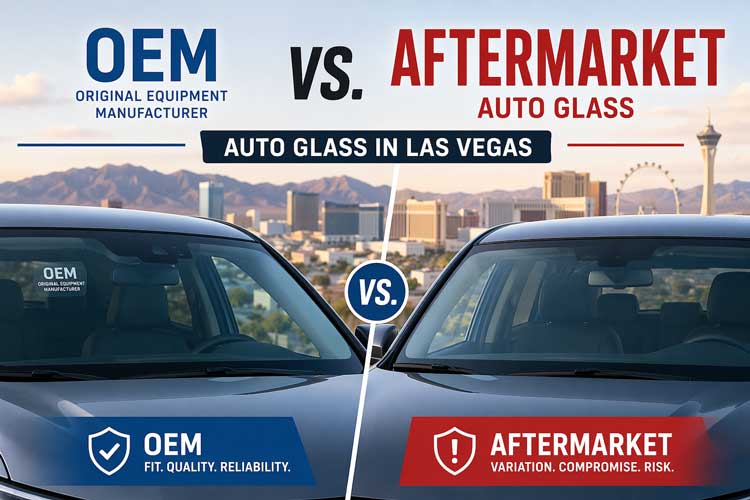
OEM vs. Aftermarket Auto Glass in Las Vegas: What Actually Matters for Safety, Fit, and Price. If you need a new windshield in Las Vegas, one question comes up fast: Should you choose OEM glass or aftermarket glass?
It sounds like a simple decision, but it really is not. The right answer depends on your vehicle, the technology built into the windshield, your insurance coverage, and how much you care about exact fit, cabin noise, tint match, and long-term value. At CA Auto Glass, we’ve been serving drivers for over 30 years through 4 Las Vegas locations, and our approach is simple: affordable pricing, great quality work, and honest advice about what actually makes sense for your car. We truly pride ourselves with excellence on auto glass repairs, whether that means OEM, premium aftermarket, or a careful repair that saves you from replacement altogether.
OEM vs. Aftermarket Auto Glass in Las Vegas
The short version is this: not every car needs OEM glass, and not every aftermarket windshield is a mistake. What matters most is whether the replacement glass matches the vehicle well enough, whether the installation is done properly, and whether any required camera calibration is handled the right way.
What “OEM” and “aftermarket” actually mean
OEM stands for Original Equipment Manufacturer. In plain English, that means glass made by the automaker or by the same supplier that built the original part to that automaker’s spec. Aftermarket means a replacement part made by a third-party manufacturer instead of the vehicle brand itself. Kelley Blue Book notes that OEM windshields almost always cost more than aftermarket ones, while Progressive explains that aftermarket parts are new third-party replacements and are commonly used by insurers when they believe those parts can return the vehicle to pre-loss condition.
That means the real-world question is not “Is aftermarket always bad?” The better question is: Does this particular replacement match the original windshield closely enough for my vehicle, my safety features, and my budget?
The safety baseline: both still have to meet federal rules
Federal law already sets a safety floor for replacement glass. FMVSS 205 covers glazing materials and exists to reduce injuries, maintain driver visibility, and reduce the risk of occupants being thrown through windows. FMVSS 212 covers windshield mounting and retention in a crash. NHTSA has also clarified that FMVSS 205 applies to glazing intended for aftermarket replacement, not just factory glass.
So from a basic legal safety standpoint, this is not a “regulated vs. unregulated” debate. Both OEM and aftermarket replacement glass still have to meet federal requirements. The bigger differences usually show up in fit, features, optics, noise, and calibration, not in whether the glass is completely outside the safety system.
Where OEM glass usually has the edge
OEM glass tends to win when you want the closest possible match to what the car had from the factory. That can matter for shape, thickness, edge finish, brackets, tint band placement, acoustic layers, and compatibility with features like head-up displays or rain sensors. The Independent Glass Association’s OEM vs. aftermarket guidance frames OEM as the safest “no-compromise” option when you want to preserve vehicle features and reduce fitment guesswork. General Motors goes even further in its official position statement, saying it does not approve aftermarket or non-Genuine OE glass for GM windshield replacement and warning that aftermarket glass may differ in material, dimensions, clarity, and acoustic performance.
That matters even more on camera-equipped cars. Honda’s service information says that for certain Acura/Honda systems, the replacement windshield must be a genuine replacement windshield, and that installing an aftermarket windshield can cause aiming to fail or the driving-support system to operate abnormally. In other words, on some vehicles, OEM is not just a “nice to have” — it is the cleanest path to getting the car back to normal.
Where a quality aftermarket windshield can still make sense
A good aftermarket windshield can still be the smart choice in plenty of situations. On older vehicles, simpler vehicles, or cars without windshield-sensitive technology, premium aftermarket glass can be a strong value play — especially if you are paying out of pocket. Progressive says insurers commonly write estimates with aftermarket parts because those parts can return a vehicle to pre-loss condition while costing less than OEM, and it notes that if you insist on OEM where aftermarket is available, you may have to pay the difference unless your policy includes OEM parts coverage.
That is why aftermarket glass often makes sense when the car is older, there is no HUD or windshield-mounted camera issue, resale perfection is not a top concern, and the replacement part is a solid spec match. Kelley Blue Book also notes that OEM replacements almost always cost more, so for many drivers the smartest move is not “cheapest glass possible,” but rather best-value glass for the car you actually drive.
What matters more than the logo in the corner
This is the part drivers often miss: the install matters just as much as the part. The Auto Glass Safety Council’s calibration guidance says it is not true that calibration automatically fails on non-OEM glass; as long as the replacement windshield meets the same specifications as the original, calibration should be possible. But AGSC also stresses that calibration needs to be done whenever the vehicle manufacturer requires it, and the ANSI/AGSC standard says recalibration must be completed using an OEM-approved or equivalent procedure when ADAS calibration is required.
That means the real checklist looks like this: the correct part, the correct adhesive system, proper cure time, proper fit, and proper static and/or dynamic calibration when the car calls for it. A premium OEM windshield can still disappoint if it is rushed through installation, and a high-quality aftermarket windshield can still work well when the specs match and the process is done right.
Why this decision gets more important in Las Vegas
Las Vegas is rough on auto glass. The National Weather Service describes Las Vegas as a city with abundant sunshine and triple-digit summer temperatures, and that kind of climate makes weak seals, poor fitment, and marginal glass choices show up faster than they might in a milder city. Heat can worsen wind noise, expose edge issues, accelerate adhesive stress, and turn tiny optical differences into noticeable glare.
That is also why local driving conditions matter in this conversation. If you spend a lot of time on hot freeways, in construction traffic, or commuting between Las Vegas and Henderson, your windshield takes more punishment than the average replacement part catalog assumes. For the local climate angle, readers often find these guides helpful: Las Vegas Auto Glass: How the Desert Climate Affects Your Car’s Windows, Safety & Longevity in Las Vegas Auto Glass Replacements, and Why Regular Auto Glass Inspections Save You Money in the Long Run.
When OEM is usually worth paying extra for
In real-life Las Vegas shop conversations, OEM is often worth the premium when:
- the vehicle is new, leased, or high-value
- the windshield works with ADAS cameras or sensors
- the car has a head-up display
- the original glass has acoustic or specialty layers
- an OEM repair procedure specifically calls for genuine glass
- you are very sensitive to wind noise, tint match, or resale feel
That is especially true for newer camera-equipped vehicles because NHTSA notes that lane-departure warning systems use a camera to detect when a vehicle is veering out of its lane. If the camera sees through the wrong optics or the bracket position is off, that is not a minor detail.
If your car falls into that category, these internal reads pair well with this topic: ADAS Windshield Calibration in Las Vegas and Windshield Repair vs. Replacement: Which Option Saves You More?.
When aftermarket is usually the smarter value choice
A premium aftermarket windshield is often the better buy when the vehicle is older, the tech requirements are simple, you are paying out of pocket, and the shop can confirm the replacement matches the original specs closely enough. In those situations, the driver may care more about getting back to safe, clear, quiet driving than paying extra for the exact brand label in the corner of the glass. That is where good advice matters more than blanket rules.
At CA Auto Glass, that is usually how we frame it: buy what your car actually needs, not what sounds impressive in a phone quote. Our FAQ specifically says we use high-quality OEM and premium aftermarket glass to match the vehicle’s original specifications, which is the balanced approach most Las Vegas drivers really need.
7 questions to ask before you approve any windshield replacement
Before you say yes to any quote, ask:
- Is the glass OEM or aftermarket, and who made it?
- Does it match my original windshield’s key specs?
- Does my car have a camera, sensor, HUD, or rain-sensor issue to think about?
- Will ADAS calibration be performed if my vehicle needs it?
- Is that calibration included in the price?
- What is the safe drive-away time for today’s weather?
- If insurance is involved, what would I pay to upgrade to OEM?
AGSC specifically recommends asking about calibration before agreeing to the work, including whether it is part of the quote and how the shop handles it. That is one of the easiest ways to separate a careful shop from a rushed one.
Why CA Auto Glass is a smart fit for this decision
At CA Auto Glass, we do not treat OEM vs. aftermarket auto glass in Las Vegas like a one-size-fits-all argument. We look at the vehicle, the windshield features, the age of the car, your insurance situation, and your budget. Then we help you make the choice that makes sense for safety, fit, and price — not just the most expensive option or the cheapest shortcut. Our Las Vegas location pages describe the company as serving the valley for over 30 years with 4 locations, and our FAQ makes clear that we work with both OEM and premium aftermarket options depending on the job.
That local experience matters. In a city where heat, freeway debris, and ADAS-equipped vehicles are all part of everyday life, the right windshield decision is usually the one that leaves the car feeling normal when the job is done: clear, quiet, well-fitted, and properly calibrated.
Final takeaway
Here is the honest version:
OEM usually wins on exact match, premium features, and fewer surprises.
Aftermarket can still be a very smart choice when the part is high-quality, the specs match, and the installation and calibration are handled correctly.
And in Las Vegas, heat, dust, and freeway driving make bad decisions show up faster than they do in softer climates.
So if you are weighing OEM vs. aftermarket auto glass in Las Vegas, the best question is not “Which one is always better?” It is:
Which one is right for my vehicle, my features, and my budget — and who is installing it?
That is the question CA Auto Glass helps drivers answer every day.