
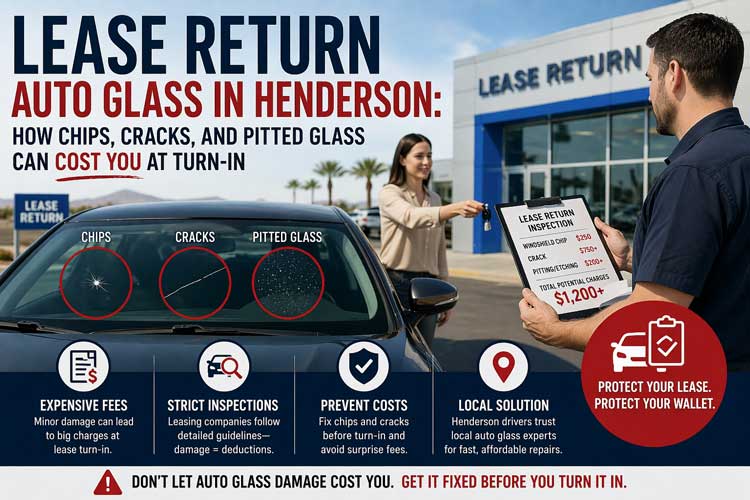
Lease Return Auto Glass in Henderson: How Chips, Cracks, and Pitted Glass Can Cost You at Turn-In. If you are getting close to the end of a lease in Henderson, there is a good chance you are already thinking about mileage, tires, and that one little dent in the bumper. What a lot of drivers miss is the glass. Lease return auto glass can absolutely affect what you owe at turn-in, and official lease-end guides from major finance companies specifically call out windshield and window damage during wear-and-use inspections.
Lease Return Auto Glass in Henderson
At CA Auto Glass, we have been helping Southern Nevada drivers for over 30 years, with 4 locations in Las Vegas, affordable pricing, and great quality work. We truly pride ourselves with excellence on auto glass repairs, and that matters when you are trying to avoid surprise charges on a leased vehicle.
This guide is built around one question: what should Henderson drivers fix before lease turn-in so chips, cracks, and pitted glass do not cost more than they should?
Why lease-return auto glass matters more than most drivers think
Lease-end inspections are not just looking for major collision damage. They are also checking for condition issues that can be billed as excess wear and use. Ford Credit’s wear-and-use card asks whether the vehicle is free of glass damage like chips and cracks, and it says excess wear-and-use charges may result if needed repairs are not completed before the vehicle is returned. Toyota Financial, Mazda Financial Services, and Volkswagen all publish similar lease-end guidance that specifically addresses windshield and glass condition.
That matters even more in Henderson. The City of Henderson says the desert climate brings about 300 days of sunshine per year, and summer temperatures can exceed 115°F. That kind of heat is hard on windshields, seals, and any chip that has been sitting there longer than it should.
If you want a broader local-weather refresher before your inspection, our article on Las Vegas Auto Glass: How the Desert Climate Affects Your Car’s Windows pairs well with this topic.
Not every lease bank treats glass exactly the same
This is one of the most important things to understand before you spend money. Lease-end standards vary. Mazda Financial Services says its examples are general guidance only and that state law and the terms of your lease can change your rights and obligations. In other words, your exact lease agreement still matters.
Still, the published rules are helpful because they show what inspectors are looking for:
- Ford Credit says all glass damage is chargeable; up to two chips or cracks per panel that each fit within a 1-inch circle are treated as repair charges, and all other cases fall into full replacement charges.
- Volkswagen says a single windshield chip without spidering counts as normal wear, but multiple chips, cracks, or pits measuring more than 1/8 inch count as excess wear and use.
- Mazda Financial Services lists windshield cracks, stars, bullseyes, and damaged, broken, or poorly installed glass as excess wear examples.
- Toyota Financial Services lists windshield cracks, stars, or bull’s-eyes, along with damaged, broken, or non-factory tinted glass, as items that may be considered excessive wear and use.
That is why “I only have a small chip” is not always enough information. The exact size, location, and type of damage matter, and so does the lease bank behind the car.
The 6 glass problems most likely to cost you at turn-in
1. Small chips that are still visible
A fresh rock chip can look minor, but at lease return it is still an inspection item. Depending on the lender, even a small chip can be chargeable, and if it grows before turn-in you may go from a repairable issue to full replacement territory. Ford’s guide is especially strict here, while Volkswagen is a little more forgiving on a single chip without spidering.
If you are not sure whether your damage is still repairable, see Windshield Repair vs. Replacement: Which Option Saves You More?.
2. Cracks, stars, and bull’s-eyes
This is the easy one. Mazda and Toyota both explicitly list windshield cracks, stars, or bull’s-eyes as excess wear examples. If you already know the glass is cracked, it is smart to treat that as a real turn-in issue, not something to leave for the lease company to sort out later.
3. Pitted glass that looks worn in bright sun
Pitting is one of the more frustrating lease-return problems because it often sneaks up on drivers. The windshield looks “fine” until bright sunlight or nighttime glare reveals that the surface is full of tiny pits and wear marks. Volkswagen specifically flags multiple chips, cracks, or pits over 1/8 inch as excess wear. On a Henderson vehicle that has spent years in desert sun, pitted glass can absolutely become part of the conversation at turn-in.
For a simple maintenance habit that helps you catch this stuff sooner, read Why Regular Auto Glass Inspections Save You Money in the Long Run.
4. Poorly installed or sloppy old windshield replacements
This is an underrated one. Mazda Financial Services specifically includes poorly installed glass in its excess wear examples. That means a bad old windshield job can still cost you at lease return even if the glass is not currently cracked. Uneven molding, ugly adhesive, bad trim fit, or obvious install shortcuts can make the vehicle look like it needs more reconditioning.
If you are wondering how to spot quality work before turn-in, our guide on Safety & Longevity in Las Vegas Auto Glass Replacements is a useful follow-up.
5. Non-factory tint or glass changes that do not match the lease standard
Toyota Financial Services lists non-factory tinted glass as a possible excess wear item, and Volkswagen calls out improperly tinted windows as excess wear and use. So if a previous owner, shop, or even you added tint in a way that does not meet the lessor’s standard, that can come back at turn-in.
6. Windshield-camera problems on newer leased vehicles
A lot of leased cars are newer vehicles with ADAS features. NHTSA says lane-departure warning systems use a camera to detect when a vehicle veers out of its lane, and IIHS notes that windshield repairs often make it necessary to calibrate crash-avoidance cameras and sensors. So if your leased vehicle has already had windshield work and there is now a warning light, a loose cover near the mirror, or a calibration issue, do not assume that is unrelated to turn-in. It can affect how the car is inspected and what work it needs next.
If that sounds familiar, our article on ADAS Windshield Calibration in Las Vegas is worth reading before you hand the keys back.
Why power windows can matter at lease turn-in, too
Lease-return problems are not always limited to the windshield itself. Ford’s checklist asks whether all electrical components are functioning properly, and Toyota’s wear-and-use FAQ includes inoperative, malfunctioning, or broken parts or equipment as issues that can matter at lease-end. If a side window is slow, crooked, or does not seal fully, that is not something you want to discover during the final inspection.
That is one reason a quick pre-turn-in check matters. Our internal post How Often Should You Check Your Car Windows and Windshield Seals? is a good place to start if you want a fast self-inspection routine.
The smartest move: inspect early, not at the last minute
The official guidance here is surprisingly consistent. Ford says a self-assessment before the final inspection gives you extra time to correct issues and make repairs. Mazda says repairs made after a pre-inspection may eliminate or reduce charges. Toyota recommends scheduling a courtesy pre-inspection within 60 days before return so you can fix damage and avoid surprises at lease-end.
That is the real financial takeaway. You do not want your first serious look at the glass to happen when the car is already being turned in.
A practical Henderson timeline looks like this:
- 60 days out: schedule or request a pre-inspection if your lease bank offers one.
- 30–45 days out: get local repair estimates on anything flagged, especially windshield damage or side-glass issues.
- Before turn-in: keep receipts if you had work done; Toyota specifically advises keeping repair receipts if you choose to fix damage before returning the vehicle.
Repair it now or let the lease company bill you later?
There is no one-size-fits-all answer, but the official lease-end guides make one thing clear: they want you to inspect early because that gives you the chance to compare your options before the car is returned. Ford says charges may result if needed repairs are not completed before return, Mazda says repairs after pre-inspection may reduce or eliminate charges, and Toyota says pre-inspection helps avoid surprises and gives you detailed estimated fees right away.
That means the smart move is usually simple: get the numbers before turn-in. Compare the likely lease-end charge to a local professional repair or replacement quote. Sometimes the fix is small and obvious. Sometimes it is better to leave minor wear alone. But you cannot make that call intelligently if you wait until the last week.
Helpful non-competitor resources
If you want to see the official standards for yourself, these are worth bookmarking:
- Toyota Financial Services – Wear & Use
- Volkswagen Financial Services – Lease Turn-In Process
- Ford Credit – Wear and Use Evaluator Card & Guidelines (PDF)
- NHTSA – Driver Assistance Technologies
Why Henderson drivers choose CA Auto Glass before lease turn-in
At CA Auto Glass, we understand that lease-return work is not just about fixing glass. It is about helping you avoid surprise charges while keeping the car safe, presentable, and easy to hand back. With over 30 years in business, 4 Las Vegas locations, affordable pricing, and great quality work, we help Henderson drivers figure out what is worth repairing, what needs replacement, and what can probably wait.
And because lease-return timelines can get tight, we focus on clear recommendations instead of upselling. If it is still a repair, we will tell you. If the glass is too damaged, poorly installed, or too pitted to be a smart repair candidate, we will tell you that too.
Final takeaway
Lease return auto glass in Henderson is one of those things that sounds minor until it becomes an itemized charge. Chips, cracks, pitted glass, sloppy old windshield replacements, non-factory tint, and even power-window problems can all matter more at turn-in than drivers expect. Official lease-end guides from Ford, Mazda, Toyota, and Volkswagen all show the same big idea: inspect early, fix what makes sense, and do not wait for the last day to find out what the lease bank thinks.
If your lease-end date is getting close, now is the time to have the glass looked at—before Henderson sun, pitting, or a small crack turns into a much bigger bill.